
When Denice Frohman stood on stage at the famed Nuyorican Poet’s Cafe in Manhattan’s Lower East Side and came out as queer at 19 while delivering a poem, honesty and urgency finally took over her soul, firmly lording over the crippling fear that consumed her.
Pushing away from authenticity within her chosen medium of poetry damaged the artistry she would strive for as a 19-year-old college freshman, yet she finally reached a point where lies were no longer an option. If she was going to be honest for those who came to her performances searching for their own truths through her work, accepting the beauty of being a queer Latina was a necessity.
“I had been lying to myself in my poems, and didn’t feel like there was space to be Puerto Rican and queer, and I didn’t know what that space looked like to claim all parts of myself unapologetically,” Frohman said. “That inflection point set me on a path to become more honest and truthful about how I lived life in my personal life. Shortly after, I started coming out to my family little by little. Poetry definitely set me on fire in the best way and saved me in a lot of ways, from a lot of shame that I had carried. Without poetry, I would have carried it a lot longer.”
For the past 20 years, living truthfully has been the through line of her life. And despite her prowess with the spoken word, her dreams of expanding into the theater genre has guided her towards a project she’s been developing for the last three years. “Esto No Tiene Nombre” (This Has No Name) is Frohman’s one-woman show that centers a group of more than 20 Latina lesbians over 50, uplifting each elder’s oral history. The voices were collected through the “I See My Light Shining: Oral Histories of Our Elders,” a project curated by MacArthur Fellow Jacqueline Woodson, part of the Baldwin-Emerson Elders Project. The show is continuing its workshop performance and regional debut at MACLA in Downtown San Jose March 21 – 23 for three performances.
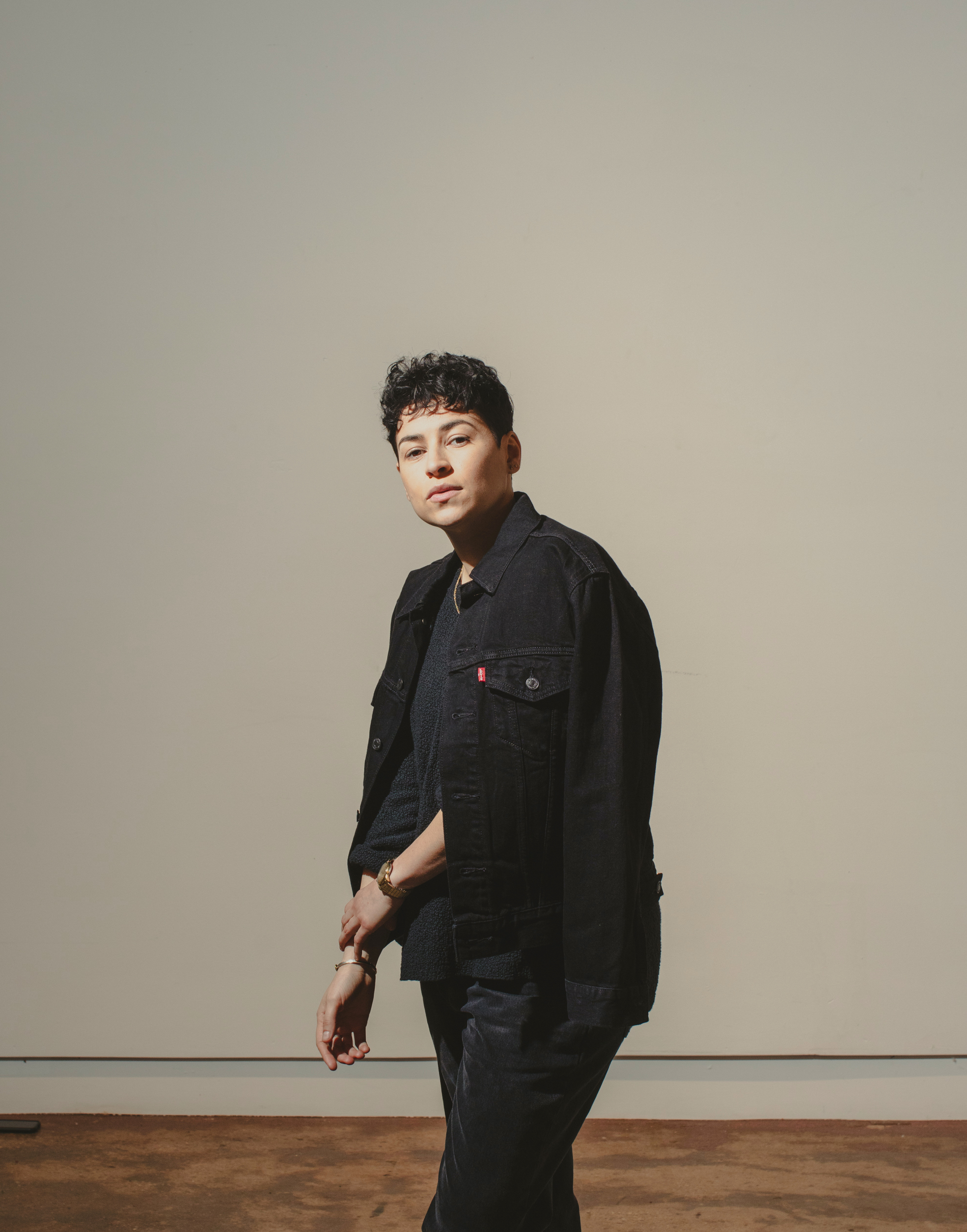
Frohman’s pathway into poetry began with her Manhattan upbringing, a resident of Hell’s Kitchen, yet she has lived in Philadelphia for many years since. Her exposure to live performance was built in an incredible way, her father a saxophone player for salsa music icon, Puerto Rican timbalero Tito Puente, for 30 years. Watching the way Puente electrified a crowd with his signature charisma and facial expressions left a profound effect on Frohman, who spent much more time perfecting her hooping skills as a college and professional basketball player than her writing skills.
“My first core memory was seeing a performer do the things (Puente) did, and then learning the purpose of performance,” Frohman said. “I didn’t see myself as a writer or a poet, and hadn’t really read any Latino poets, but stumbling into the Nuyorican Poet’s Cafe at 17-years-old changed my life. It was the first time I saw poets who sounded and looked like me, sharing their stories unapologetically on stage.
“It was those moments that allowed me to step into my own truth. I was growing out of a version of myself that was never really me, and I needed a space to figure that out.”
An expansion from poetry performance to acting is deceptively difficult. Director Alex Torra immediately noticed Frohman’s magnetism, realizing she was a gifted performer in her own right.
“Denice has a very special skill on stage, a real presence, and the material feels like it’s rooted deeply in her bones, her skin, and inside her experience in a really true and authentic way,” said Torra, who was raised in Miami and, like Frohman, lives in Philadelphia. “When it speaks, it resonates hard, and that became clear very quickly. The performance of poetry has embedded in it a kind of acting that maybe doesn’t follow the exact rules of theater acting but it requires a kind of connection to a truth and a story.”
Because this is a piece that plays by specific rules of theater, Torra, whose specialty is devising new works, provided space for a learning curve that Frohman readily accepted.
“How do you create a rhythm, a process that’s good for the performer? This is Denice’s first theater piece, so the process requires a kind of learning about what she needs in order to make and perform it,” Torra said. “She’s not coming from a theater background, so there’s a lot of discovery that requires a kind of patience and listening, making space and time for the process that is needed to get to where we want.”
Frohman’s award-winning career has spanned some staggering highs throughout the nation, including a plethora of commissions and poetry slam competition wins, well known as the creator and performer of the poem, “Accents.” Speaking with Frohman means being struck by her wit and candor. She possesses a soft timbre in her voice, a buttery smooth delivery with a wisp of her own accent that says East Coast. Watching “Accents” is being introduced to an existence with zero apologies, feeding off the crowd that validates every relatable metaphor. That artistry is the reason why the amount of hardware under her belt in the poetry world is vast, but this challenge outside her comfort zone offers a chance to stretch her abilities.
In looking back at both life and career, Frohman’s journey as a queer Puerto Rican and renowned poet is not simply about the road she’s traveled on by herself. Coming out in a heteronormative society means the people that loved and raised someone have to come out too, in a specific sense. To that end, some of the most powerful words the play offers are in regards to the relationship between Frohman and her mother, and she is quick to affirm that they are very close. But that closeness did not just show up unannounced. There was a commitment to learning the language needed, which Frohman’s mother accepted, so a queer daughter could receive the unconditional love she deserves.
“Sometimes queerness is a place of exploration and creating your own rules,” Frohman said. “I think one of the most vulnerable places to be is to invite the audience to see this close, very committed and loving relationship between a mother and daughter, with that daughter making space for that mom to learn the language.”
ONLINE: denicefrohman.com
INSTAGRAM: @denicefrohman

WHAT TO KNOW IF YOU GO
“Esto No Tiene Nombre”
A workshop performance and regional debut
Written and performed by Denice Frohman
Directed by Alex Torra
Friday and Saturday, March 21 and 22 – 7:30 P.M.
Sunday, March 23 – 1:30 P.M.
75 minutes no intermission
MACLA/Movimiento de Arte y Cultura LatinoAmericana
510 S. 1st St., San Jose
Tickets range from $12.51 to $49.87
For tickets and information, visit maclaarte.org




 Bay Area Plays.com
Leave a comment